Puerto Vallarta Guide: Where to Stay, Beaches, and Day Trips
In this guide
Stay in the Zona Romántica, budget one day for the town itself, and spend the rest on Banderas Bay — that is the short version of doing Puerto Vallarta well. PV is the rare Mexican beach destination that is also a real town, with a walkable old center, a genuine food scene, and a bay full of boat-access beaches. This guide compares the three main areas to stay, ranks the beaches, covers the Malecón, and maps out the two classic day trips: Yelapa and Sayulita.
Orientation: one bay, three very different bases
Puerto Vallarta stretches along Banderas Bay, one of the largest bays on the Pacific coast of the Americas. From south to north: Zona Romántica and the old town (Centro), then the Hotel Zone, then Marina Vallarta by the airport, then — across the state line into Nayarit — Nuevo Vallarta and eventually Sayulita.
| Area | Best for | Character | Typical lodging cost (approx.) |
|---|---|---|---|
| Zona Romántica | First-timers, food and nightlife, LGBTQ+ travelers | Cobblestone streets, dense, walkable | Roughly $60–180 USD/night |
| Marina Vallarta | Families, golfers, cruise passengers | Resort-calm, marina boardwalk | Roughly $80–250 USD/night |
| Nuevo Vallarta | All-inclusive vacations | Master-planned, wide quiet beach | Roughly $150–400+ USD/night AI |
Zona Romántica
South of the Cuale River, the Zona Romántica (also called Old Vallarta or Emiliano Zapata) is the answer to “where should I stay?” for most independent travelers. It packs restaurants, cafés, galleries, and one of Latin America’s most established LGBTQ+ scenes into a grid of cobblestone streets that ends at Playa Los Muertos, the town’s main beach. You can walk everywhere, eat differently every night for two weeks, and never need a car.
Marina Vallarta
Built around a yacht marina near the airport, this area trades character for convenience: big-name resorts, a golf course, a pleasant evening boardwalk around the slips. The beach here is wide but the sand is darker and the water less inviting than farther south. Pick it for a low-effort family or golf trip.
Nuevo Vallarta
Technically a separate development in Nayarit state, 25–40 minutes north of downtown. This is all-inclusive territory — enormous resorts on a long, calm beach. If your plan is “resort, pool, swim-up bar, repeat,” it delivers. If you want Mexico outside the gates, you will be commuting to it.
The beaches, ranked for actual use
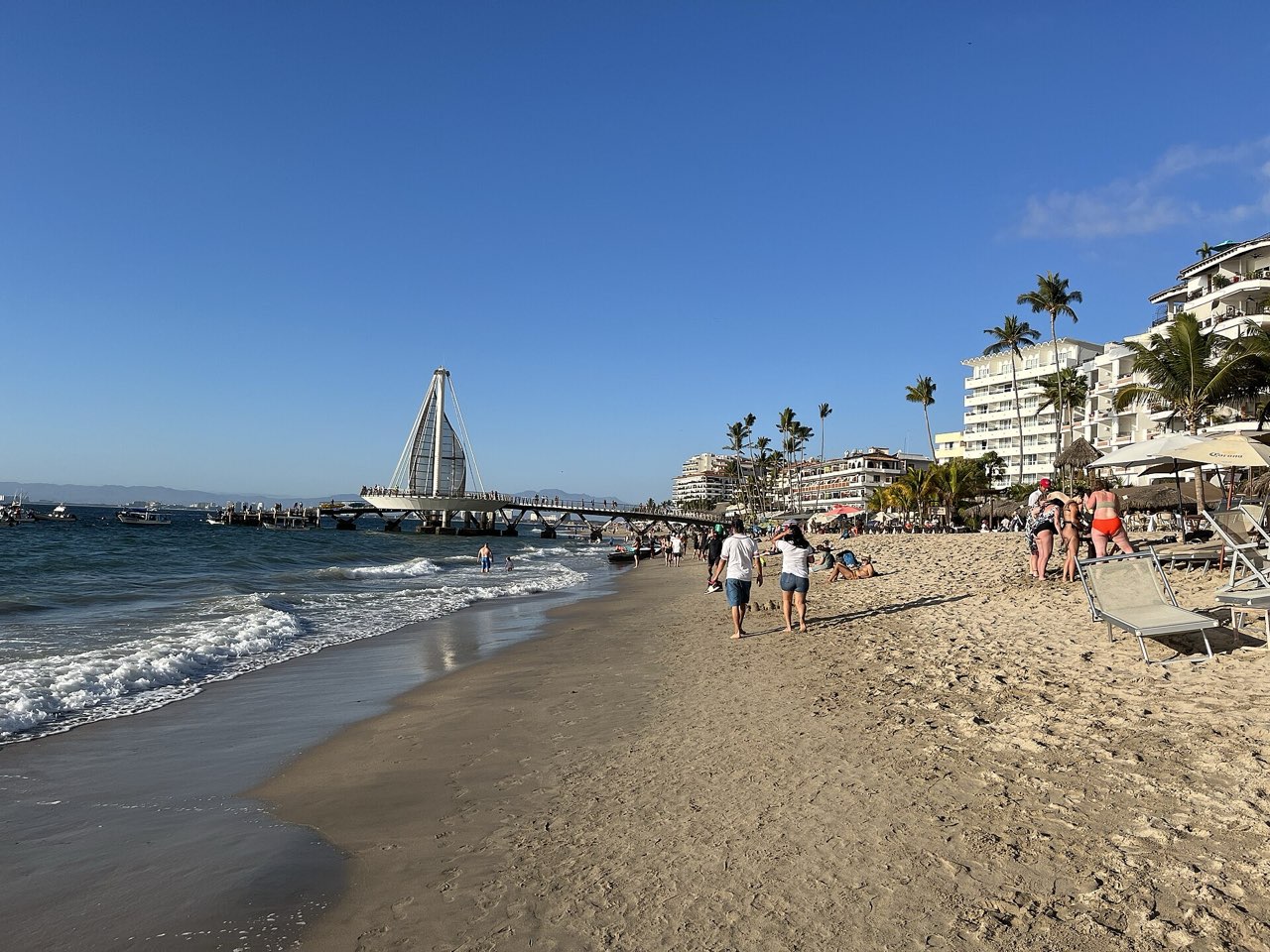
- Playa Los Muertos — the main event in the Zona Romántica: lively, swimmable, lined with beach clubs and palapa restaurants, anchored by the modern pier. Not tranquil, always fun.
- Conchas Chinas — a short ride south of town: small coves, boulders, clearer water, far fewer people. The closest thing to a quiet swim near the center.
- Playa Las Gemelas / Punta Negra — south-shore pocket beaches with some of the bay’s clearest water; go early to claim sand.
- Boat-access beaches (Las Ánimas, Quimixto, Majahuitas, Yelapa) — the southern shore of the bay has no road, so these beaches are reached by water taxi from Boca de Tomatlán or Los Muertos pier. Las Ánimas is the family pick; Yelapa deserves the full day trip below.
Swimming in Banderas Bay is generally friendlier than on Mexico’s open Pacific coast — the bay knocks down the swell — but respect flag warnings, particularly in the summer storm season.
The Malecón
Puerto Vallarta’s mile-long oceanfront promenade runs along downtown and is the town’s living room. Walk it in the late afternoon into evening: sand sculptors, the famous bronze seahorse statue, the Voladores de Papantla performing their spinning pole ritual, street food carts, and a sunset over the bay nearly every night of dry season. It connects downtown to the Zona Romántica across the Cuale River, so it doubles as your commute. The Church of Our Lady of Guadalupe, with its crown-topped tower, sits a block inland and is the skyline’s signature.
Day trips
Yelapa
A fishing-village-turned-bohemian-cove on the roadless south shore, reached by a 45-minute water taxi from Los Muertos pier or a shorter hop from Boca de Tomatlán. You get a proper beach with palapa restaurants, a 20–30 minute walk up the river to a waterfall, and the deeply pleasant feeling of a place cars cannot reach. Water taxis run roughly 300–450 MXN round trip; confirm the last return departure when you land, because it is real.
Sayulita
An hour or so north into Nayarit, Sayulita is the surf town the whole coast talks about: beginner-friendly waves, board rentals and lessons everywhere, a walkable center dense with taco stands, boutiques, and bars under strings of papel picado. It is crowded and knows it is charming — go on a weekday to see it at its best. Buses from Puerto Vallarta cost pocket change; a taxi or Uber runs roughly 700–1,000 MXN each way. Neighboring San Pancho, ten minutes farther, is the quieter sibling if Sayulita feels like too much.
Other options: the Marietas Islands (boat tours to a protected wildlife refuge, capacity-limited), whale watching December through March when humpbacks calve in the bay, and the mountain town of San Sebastián del Oeste for a cool-air colonial contrast.
Eating in Puerto Vallarta
PV eats far better than the average beach resort town, and the range is wide:
- Beach and street level: fish-on-a-stick (pescado embarazado) from Los Muertos vendors, marisco carts serving ceviche tostadas and aguachile, and birria from morning market stalls. A serious seafood-cart lunch runs roughly 100–200 MXN.
- The taco blocks: the streets a few blocks inland from the water in both the Centro and Zona Romántica hold the locals’ taquerías — al pastor after dark, carnitas and birria in the mornings.
- Sit-down: the Zona Romántica’s restaurant density supports everything from family fondas to chef-driven rooftop dining; mains at the upper end run roughly 250–500 MXN, still well under equivalent US resort-town pricing.
- The Wednesday farmers’ markets (seasonal, high season) in the Romántica are worth timing if you have a kitchen.
When to go
- Mid-November to April (high season): dry, sunny, mid-to-high 20s °C, low humidity, warm sea. December–March adds humpback whales. Book ahead for Christmas through Easter, when prices peak.
- May–June and September–October (shoulder/low): hot and increasingly humid; September is the wettest and quietest month. Prices drop substantially.
- July–August: hot, humid, and rainy — but the rain is mostly dramatic afternoon and evening storms, and Mexican summer vacationers keep the town lively.
Practical notes
- Getting around: Local buses are cheap and cover the coast road; Ubers and taxis are plentiful (agree on taxi fares first, or just use the app — see our safety guide on taxis vs Uber).
- Money: Resorts and restaurants take cards, but beach palapas, buses, and water taxis want cash. Our Mexico money guide covers the ATM and tipping details.
- Food: Do not leave without a fish-on-a-stick from a Los Muertos beach vendor and birria from a market stall — our street food guide has the how-to-choose-a-stand rules.
- How many days: Four to five is right for town plus beaches plus one day trip. A week works if you add Sayulita and a boat day.
Puerto Vallarta suits travelers who want a beach trip with a town attached rather than a resort with a lobby attached. If your ideal Mexico trip leans more culture-first with a beach finale, compare our 10-day itinerary, which routes through Mexico City and Oaxaca instead — or simply do both trips. The country supports repeat visits better than almost anywhere.
Frequently asked questions
Which area of Puerto Vallarta is best to stay in?
Zona Romántica is the best all-around choice for most visitors: walkable, full of restaurants and bars, and steps from Playa Los Muertos. Marina Vallarta suits golfers and families wanting resort calm, while Nuevo Vallarta is the all-inclusive zone north of the airport.
When is the best time to visit Puerto Vallarta?
Mid-November through April brings dry, sunny weather with warm seas and low humidity — this is high season. Summer is hot, humid, and rainy but much cheaper, with afternoon storms rather than washed-out days.
Is Puerto Vallarta walkable?
The central stretch is. You can walk the Malecón from downtown to Zona Romántica in about 20 minutes. Marina Vallarta, the Hotel Zone, and Nuevo Vallarta are spread out and rely on taxis, buses, or Uber.
Can you swim in the ocean at Puerto Vallarta?
Yes. Banderas Bay is one of Mexico's calmer Pacific swimming areas because the bay blunts open-ocean swell. Conditions vary by beach and season, so follow flag warnings, especially in summer.
Keep planning
- Mexico City First-Timer's Guide: Where to Stay and What to See
Where to stay in Mexico City (Roma Norte vs Condesa vs Polanco), the top sights grouped by neighborhood, how to get around, and how many days you need.
Updated Oct 2026 - Oaxaca City Guide: Food, Mezcal, and Day Trips Worth Planning For
Why Oaxaca City is Mexico's food capital: the markets, mole, and mezcal to seek out, Monte Albán and Hierve el Agua day trips, when to visit, and where to stay.
Updated Oct 2026 - San Miguel de Allende: What to Do and How to Get There
What San Miguel de Allende actually is, the highlights worth your time, hot springs day trips, getting there from CDMX or QRO, and how many days to stay.
Updated Aug 2026