San Miguel de Allende: What to Do and How to Get There
In this guide
San Miguel de Allende is a 500-year-old hillside colonial town in Mexico’s central highlands that reinvented itself as an arts destination — and it earns most of its hype. There is no airport, no beach, and no single blockbuster sight; the town itself is the attraction. This guide explains what San Miguel actually is, the highlights that justify the trip, the day trips worth adding, exactly how to get there from Mexico City or Querétaro, and how many days to give it.
What San Miguel de Allende actually is
San Miguel is a UNESCO World Heritage town of about 70,000 people (plus a large seasonal expat population) at 1,900 meters in Guanajuato state, roughly halfway between Mexico City and the historic silver cities. Its bones are 17th- and 18th-century baroque: ochre and terracotta facades, carved doorways, cobblestone streets that climb the hillside from the central square, the Jardín Allende.
Two things distinguish it from other pretty colonial towns. First, preservation: strict rules keep the historic center visually intact — no traffic lights, no neon, no towers. Second, the arts economy: American artists began settling here in the 1940s around the Instituto Allende, and the town has compounded that head start into galleries, design shops, cooking schools, and a restaurant scene wildly out of proportion to its size.
The honest caveat: San Miguel is polished, expensive by Mexican standards, and English is everywhere in the center. If you want gritty authenticity, this is not that trip — pair it with Mexico City or Oaxaca for contrast.
The highlights
La Parroquia and the Jardín
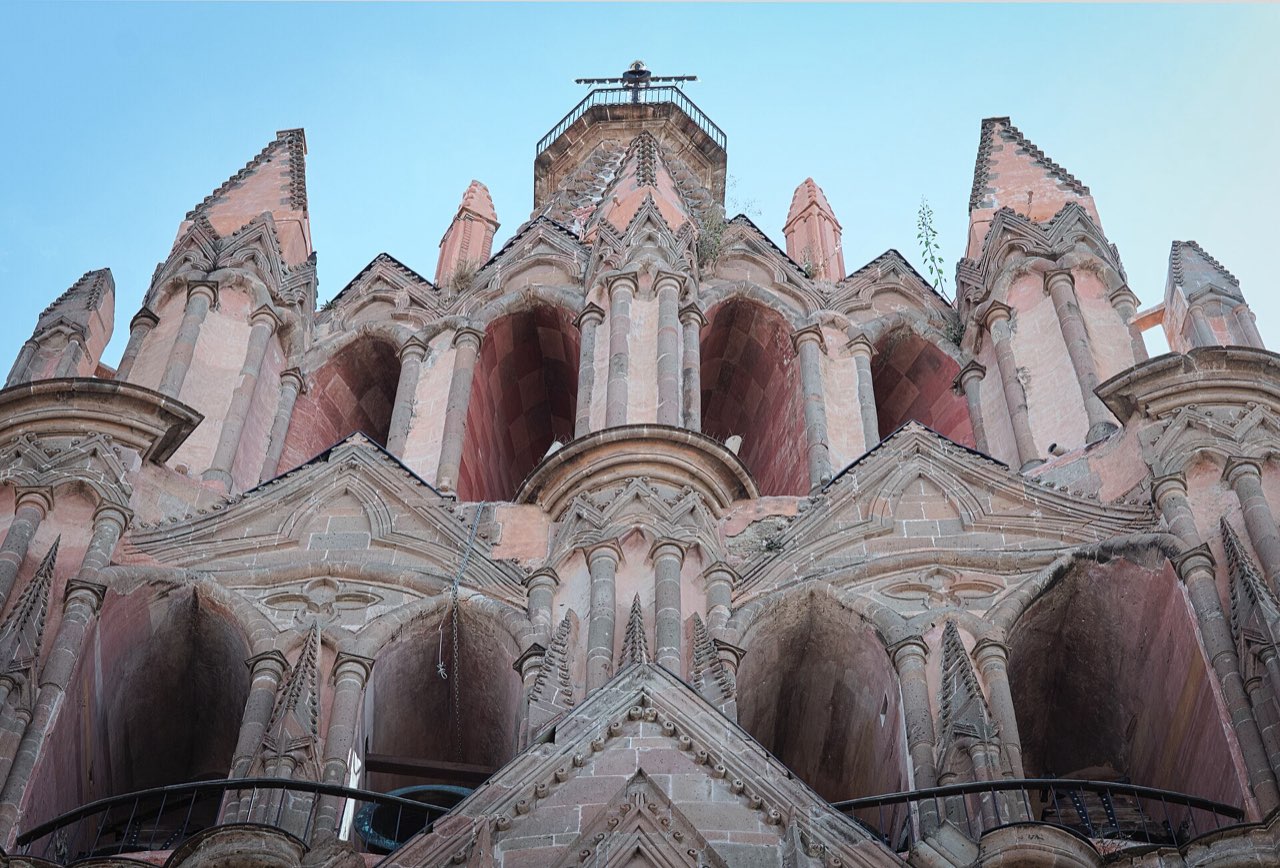
The Parroquia de San Miguel Arcángel — the pink neo-Gothic parish church whose spires appear on every photo of the town — anchors the Jardín, the tree-lined central square. The story is part of the charm: a self-taught local mason reportedly designed the 19th-century facade from postcards of European cathedrals. The Jardín is the town’s social engine; take a bench at dusk when the light turns the facade rose-gold and mariachis start circulating.
Walk the center with no plan
San Miguel rewards aimlessness more than checklists. The blocks bounded roughly by Calle Aldama (the classic Parroquia photo street), Recreo, and Canal hold most of the doorways, courtyards, and rooftops you came for. Duck into any open door — hotels, restaurants, and galleries occupy colonial courtyards, and looking is free.
Fábrica La Aurora
A former textile mill on the north edge of the center converted into a design and art complex: dozens of galleries, studios, antique dealers, and a couple of cafés. It is the single best concentration of the town’s arts scene and a reliable half-day, especially when the midday sun makes hill-climbing unattractive.
El Mirador and rooftops
The overlook on the road up toward Querétaro gives the classic panorama of the town spilling down to the plain. Go for sunset, or skip the walk and take any of the center’s many rooftop bars — the skyline drink is a San Miguel institution.
El Charco del Ingenio
A botanical garden and canyon reserve above town dedicated to Mexican high-desert flora — cacti, wetlands, canyon views. A good morning counterweight to all the boutiques.
Day trips
| Day trip | Distance | Why go | Approx. cost |
|---|---|---|---|
| Hot springs (La Gruta, Escondido Place) | 15–20 min | Thermal pools fed by natural springs; La Gruta’s tunnel pool is the crowd favorite | Roughly 250–450 MXN entry |
| Atotonilco | 20 min | UNESCO sanctuary whose interior murals earn the nickname “the Sistine Chapel of Mexico” | Small donation; combine with hot springs |
| Dolores Hidalgo | 45 min | Birthplace of Mexican independence; Talavera pottery workshops and famously eccentric ice cream flavors | Bus or taxi, roughly 100–400 MXN |
| Guanajuato city | 1.5 hr | The tunnel-riddled, alley-stacked university city — arguably a destination in its own right | Bus roughly 150–250 MXN each way |
| Wine country (San Miguel vineyards) | 20–40 min | The Guanajuato wine route has matured fast; tastings and vineyard lunches | Tours roughly 1,000–2,000 MXN |
Getting there
From Querétaro (QRO) — the easy way. Querétaro International Airport is the closest airport, about 1.5 hours away. Direct shuttle services and prearranged private drivers run roughly 900–1,800 MXN; there is no useful public transit link, so book transport before you land. QRO has direct flights from several US hubs.
From Mexico City (MEX). Around 3.5–4 hours door to door:
- First-class bus (ETN or Primera Plus) from Terminal Norte — comfortable reclining seats, roughly 500–800 MXN, several departures daily. This is the standard budget-to-midrange move. Note that the CDMX airport to Terminal Norte transfer adds time and a taxi/Uber ride.
- Direct door-to-door shuttles — companies run airport-to-San-Miguel vans, roughly 1,000–1,800 MXN per person, worth it to skip the terminal shuffle.
- Private driver or rental car — about 3.5 hours on good toll highways; tolls add up but the roads are excellent.
If San Miguel is part of a longer first trip to Mexico, it works best as a 2–3 day add-on to a Mexico City base — see our 10-day itinerary for how the pieces fit, and our Mexico City guide for the anchor city.
Where to stay and what it costs
Stay inside the historic center or just uphill of it — the whole point is stepping out your door into the scenery. Boutique hotels in colonial houses are the town’s specialty and run roughly $120–400+ USD/night at the well-known end; guesthouses and B&Bs a few blocks out drop to roughly $50–120 USD. Book well ahead for weekends, Day of the Dead, and the Christmas–New Year stretch — San Miguel is a favorite weekend escape for Mexico City residents, so Saturday availability is a real constraint.
Food spans street level to destination dining: tacos and market stalls at normal Mexican prices (see our street food guide), and a top tier of restaurants where mains run roughly 300–600 MXN. Overall, budget more than you would for Oaxaca and less than a US trip.
Eating and drinking
San Miguel’s food scene punches far above its 70,000-person weight, and it splits cleanly into tiers worth mixing:
- Market level: the Mercado Ignacio Ramírez and the adjoining artisan corridor serve proper cheap eats — gorditas, enchiladas mineras (the regional dish, tortillas fried in guajillo sauce with potatoes and carrots), and fresh juices at everyday prices.
- Street level: evening taco stands cluster around the Plaza Cívica and along Insurgentes; Wednesday and Sunday bring more vendors out.
- Destination level: the rooftop-restaurant tier is where San Miguel competes nationally — book the well-known rooftops ahead for sunset seatings, and expect near-CDMX pricing.
- Drinking: the town has quietly become a cocktail destination, and the surrounding Guanajuato vineyards supply local wine lists that did not exist fifteen years ago.
How many days
Two to three days is right. Day one: the Jardín, the Parroquia, and unstructured center wandering with a rooftop sunset. Day two: Fábrica La Aurora, El Charco del Ingenio or the Mirador, and the town’s shops and galleries. Day three, if taken: hot springs plus Atotonilco, or the Guanajuato day trip. Beyond three days, San Miguel becomes a place you relax rather than a place you explore — which, judging by the number of visitors who ended up buying houses here, is exactly how it gets you.
Frequently asked questions
How do I get to San Miguel de Allende?
There is no airport in town. Fly into Querétaro (QRO), about 1.5 hours away by shuttle, or Mexico City (MEX), about 3.5 to 4 hours by bus or shuttle. From CDMX, first-class buses run from the Terminal Norte to San Miguel several times daily.
How many days do you need in San Miguel de Allende?
Two to three days covers the town well: one for the historic center and galleries, one for the Fábrica La Aurora and viewpoints, and an optional third for a hot springs or wine country day trip.
Is San Miguel de Allende walkable?
Yes — the historic center is compact and everything sits within a 15-minute walk of the Jardín. Be ready for steep cobblestone streets and uneven sidewalks; comfortable shoes matter more here than in most Mexican cities.
Why is San Miguel de Allende so famous?
It is a UNESCO World Heritage colonial town with a strikingly preserved historic center, a decades-old international arts scene, and a large expat community. Travel magazines have repeatedly named it among the best small cities in the world.
Keep planning
- Mexico City First-Timer's Guide: Where to Stay and What to See
Where to stay in Mexico City (Roma Norte vs Condesa vs Polanco), the top sights grouped by neighborhood, how to get around, and how many days you need.
Updated Oct 2026 - Oaxaca City Guide: Food, Mezcal, and Day Trips Worth Planning For
Why Oaxaca City is Mexico's food capital: the markets, mole, and mezcal to seek out, Monte Albán and Hierve el Agua day trips, when to visit, and where to stay.
Updated Oct 2026 - Puerto Vallarta Guide: Where to Stay, Beaches, and Day Trips
Puerto Vallarta explained: Zona Romántica vs Marina vs Nuevo Vallarta, the best beaches, the Malecón, day trips to Yelapa and Sayulita, and when to go.
Updated Aug 2026